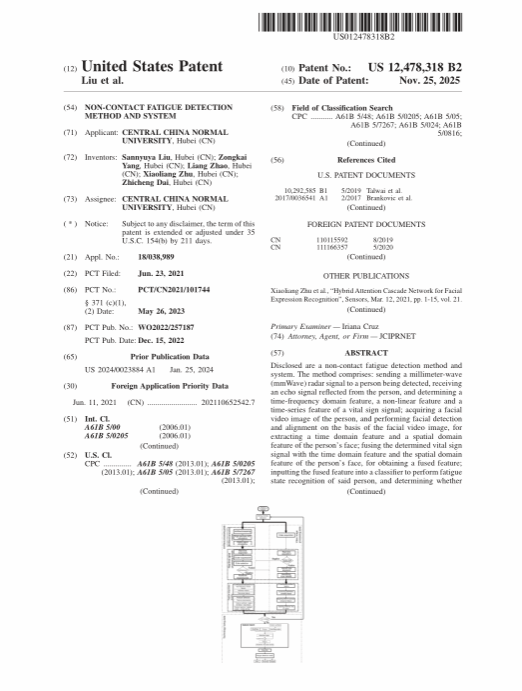
Disclosed are a non-contact fatigue detection method and system. The method comprises: sending a millimeter-wave (mmWave) radar signal to a person being detected, receiving an echo signal reflected from the person, and determining a time-frequency domain feature, a non-linear feature and a time-series feature of a vital sign signal; acquiring a facial video image of the person, and performing facial detection and alignment on the basis of the facial video image, for extracting a time domain feature and a spatial domain feature of the person's face; fusing the determined vital sign signal with the time domain feature and the spatial domain feature of the person's face, for obtaining a fused feature; inputting the fused feature into a classifier to perform fatigue state recognition of said person, and determining whether the person is in a fatigued state by the fused feature. By fusing the two detection techniques, the method effectively suppressing the interference of subjective and objective factors, and improving the accuracy of fatigue detection.


 友情链接
友情链接
 联系我们
联系我们